Thursday, April 9, 2015

The Incredibles

Taylor Dennis
Blog 4
The Incredibles
           
            The Incredibles is a Disney movie that was released in 2004. This children’s film is about a family with super human powers who has given up the life of defending the world to live a normal life. The two older children, Dash and Violet, struggle with living a normal life and hiding the powers they secretly have. After figuring out that their parents, Mr. Incredible and Elasta Girl, have secretly been taking jobs where they can use their powers, the children decide to follow them on their next mission. On this mission, Mr. Incredible runs into a surprising enemy, a fan from his past. This film takes you on a journey with the family as they try to reign in their powers, become closer to one another, and save the world from evil villains.
            One negative message within the film is Mr. Incredibles treatment of his young fan, Incredible boy. In the beginning of the film, there is a scene where a young boy dresses like Mr. Incredibles sidekick and asks to accompany him on a police chase. Instead of acting like a gracious and nice super hero like many comics like to portray, Mr. Incredible is extremely rude and kicks the young boy out of his car, crushing his dream. As the film goes on, you realize that this young boy was very hurt by the way his idol treated him. The anger he felt through these incidents led him to change his mindset from wanting to be a super hero to wanting to be a super villain. I think this portrays a negative message for what “super hero’s” should be. Children look up to super hero type figures and we expect them to be an excellent role model. These scenes give the impression that it is okay to treat others who do not have the same talents as you as less than yourselves. While Mr. Incredible does make up for his actions as the film goes on, I do not think that this is the way that super heroes should treat others.


            A positive message within the film is women superhero’s being as strong and powerful as the male superhero’s. In many cases, the women have the position as side kick or helper. In The Incredibles, both the daughter and mother have very strong superpowers that are just as useful as the males powers. Through out the film, they show that women can beat just as many villains as the father and son. In the beginning, Violet struggles to be confident as a person and with her invisible abilities. After being tested like never before, Violet is able to tap into her inner powers with a force field and help to save her family.  Violet learns to embrace her powers and change from the shy, timid girl to one that embraces her powers.  She uses her tallents for good and becomes a strong women figure in the film. Both Violet and Elasta Girl are positive role models for young girls. They represent what young girls should look up to, super women who use their powers for good and make names for themselves away from their male counterparts.


            I think that the message of strong women characters is the most prominent in the film. Usually, films relating to super hero’s are targeted to boys and men. This film is not directly targeted to boy or girls, but shows girls what a strong super women character looks like. Violet and Elasta Girl’s characters prominently portray what super powers a women can have, which are equal to the super powers a man can have. I think that these characters send a positive message to young girls.


~Taylor Dennis

Blog 4 - Peter Pan


Blog 4 – Disney’s Peter Pan

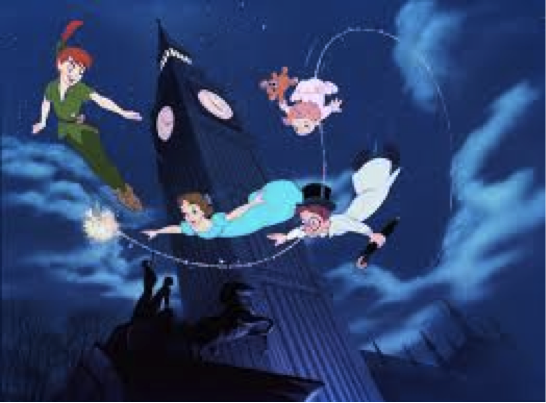
Growing up, Peter Pan was always one of my favorite movies, considering I named my cat after Tinker bell. Disney adapted J.M Barrie’s classic tale in 1953. The folk tale follows the adventures of a boy who couldn’t grow up, lives in Neverland with his gang of lost boys, and a series of other fantastical creatures and people that seem to only live in the minds of children. While this film brings forward the grim reality that everyone must eventually grow up, it seems to sugarcoat that reality with fantasy. This can be misleading. As children, it is hard to completely understand the complex thinking that the creator of this classic story went through to write it.


On particularly alarming part of the movie that can leave an impression on children is the fact that Peter Pan is actually kidnapping Wendy and her brothers and taking them to Neverland. “Stranger danger” is a popular phrase parents teach children in adolescence to prevent them from trusting anyone they don’t know. For obvious reasons, it seems like a good idea to teach kids that they should always run away from the unknown. They don’t have the mature judgment it takes to assess a situation as safe or unsafe. Most children will trust any adult unless told or trained otherwise. Yet on the other hand, while watching this film, children can see what it is like to leave home and take a chance, especially with a “new friend” they have just met. Adventures and stories are so real to children, like they are in this film, and this can be a dangerous association. Not to mention that the children can fly out of their window. That is a complete different risk.


The film does, however, showcase the importance of the imagination. In the beginning of the film, Wendy, the oldest sister, is ordered by her father to stop telling stories to her younger brothers, and that it is “time for her to grow up”. This causes Wendy to fear of growing up, because the only description she has of doing so is to forfeit her imagination and creativity. As she embarks on and returns from her adventures in Neverland, she returns home to her parents and is suddenly oddly comfortable with the thought of growing up, because of her realization that your imagination never really leaves you as you mature. For me, I was so excited to grow up, go to college, get a job, drive a car, etc. These milestones, however, are believed to come with the price of your innocence and your imagination. While your dreams and stories may mean something a little different to you, they are still alive inside of you, and always will be. This was an important lesson I learned (almost subconsciously) as a child. Growing up is not all sunshine and roses, but it is not all the evil that Peter Pan describes it as. There are positives and negatives, as there are with everything in life.


Ultimately I believe that the positive lesson of this story outweighs the negative aspects of it. Personally, as a child, I never associated Peter Pan with a stranger.
He was a child, and he was someone the children in the nursery were familiar with, as they had grown up listening to stories about his adventures. Fe felt like a friend to them, which is why I don’t think any children watching this film view him as a stranger. As a whole, it is a lesson meant for both children and adults about the necessary aspects we have in life. For example, at the end of the film, you feel sorry for Peter, even though he is happy to be returning to Neverland. He will likely never know true love, or know how it feels to be a parent or to be successful at his job. While childhood is a fun and magical time, adulthood – for different reasons – is full of fun and magic as well.

Messages in Rio 2

During Rio 2, there was not much of s structure to the story line. As usual with being a sequel, there was not as much praise regarding this movie.  The vibrant colors of the different birds and sceneries made the surface of the movie extravagant. Then, following the structure of the film, the storyline did not capture my attention as much. I believe the only saving grace of the movie for keeping a child interested in and entertained during it is the vibrant colors and movements. There are potentially both positive and negative messages that could be pulled from this film, although I do not believe children would pick up on most of them. The negative messages are more so picked up by adults who may not want their kids exposed to such messages, although not easily detected by children.

Commonly with children’s films, a positive message to help the environment is somehow put into the film. With Rio 2, there are many different scenes that encourage general good care and respect of the environment. Starting off in the first ten minutes of the movie, two of the characters, Linda and Tulio, are in the Amazon Forest releasing a bird back into the wild. Linda is seen as one of the main characters that owned what they thought was the last of the rare Spix Macaw parrots. In both the first and second movie, Linda is portrayed as an environment friendly girl. A second Spix macaw parrot is found and put together with her parrot, Blu, and they now have a family, hoping to kick-start the species back into the wild. A subtle way the film encourages helping the environment is by making the colors vibrant and interesting. This can help kids understand and potentially question the actuality of the forest looking so pretty. Also this can help prove the point that helping save the environment can better the forest. Later on after the flocks of Spix Macaws are found in the forest, the race is on to stop loggers from cutting down the forest and destroying the homeland of these birds. Linda and Tulio, with the birds help as well, fight against the loggers attempting to cut down large areas of forest. Their fight against the loggers helps children see the potentially devastating effects it has on different species in the forest while they are seeing people taking action against logging. Environment education is becoming more and more necessary as industrialization occurs and this movie is a good representation of such for children.

Along with positive messages, negative messages can potentially be pulled from Rio 2. From the beginning of the movie, Blus children do not give him the respect he deserves as a father, as most people teach their children. The children declare that Blu always says no to them and does not let them do anything they would like to do. Blu justifies his response by declaring they must stay safe since they are the last of their kind. Although subtle and does not occur often in the movie, this scene is especially powerful in my view, to adults and children. With the kid birds attempting to do something potentially very dangerous and then being upset with their father and complaining about him saying no can negatively influence children.


With both positive and potentially negative messages in children’s films, some are more overt than plainly understood. I believe the negative message put out from the children disrespecting their father potentially has the most powerful effect on the target demographic, children, because of the lack of discipline rampant throughout America. If it is shown in movies and picked up by kids, the children are going to wonder why when they do the same thing it is wrong but they saw it in a movie where punishment was not put into place at the time of disrespect. In contrast, there are not many scenes portraying disrespect from the children and thus may be easily overlooked.

Messages in Anastasia

As we have recently discussed in class, and as I am becoming increasingly aware of myself, movies express more messages than meet the eye. Some messages are outwardly stated, while others are subtle and only picked up on when you are looking for them. I have begun to wonder if the subtle messages get noticed by our subconscious minds, and perhaps, reverberate in our brains even when we were unaware that we even picked up on them. Many childrens movies get chided for this very reason. While some people would argue that children do not pick up on these covertly expressed messages, and only see the positive themes of children’s movies, others would say that many of these hidden messages are negative and misdirect children, even if unconsciously noticed.
For my Blog 4, I chose to analyze one of my favorite movies from when I was younger, and quite frankly I was shocked by all I the things I had not picked up on before. The movie Anastasia is about a Russian princess whose family, save for her grandmother, is murdered by an evil sorcerer of sorts named Rasputin. Only Anastasia and her grandmother survive but are separated during their escape when Anastasia falls and hits her head, resulting in amnesia. She grows up as an orphan, not knowing where she came from of who her family is, only guided by one clue: a necklace left to her by her grandmother that reads “Together in Paris.” The movie is about Anastasia and the two conmen who eventually help her reunite with her grandmother. And of course, as all princess movies go, Anastasia falls in love along the way with one of the men, Demitri.
The movie is somewhat based on the actual execution of the Romanov family, the Imperial family of Russia. One of the things I was most shocked I had never realized before was that in the film, the revolution is not caused by civil unrest with the monarchy, instead it is caused by a curse that was cast on the royal family… this was an interesting twist on the facts of what actually happened. I interpreted this as one of those subtle messages, imprinting the idea that a what truly made the people the most happy was being ruled over by a monarchy rather than elected officials. 
The entire movie is obsessed with the idea of royal pedigree. Anastasia is nothing more than a poor, grungy orphan before the conmen plant the idea that she could be a princess inside her head. And only after she transforms to fit her new role is she seen as desirable. This movie weighed heavily on the importance of a hierarchy, and near the end when it is revealed that Anastasia truly is the princess, Demitri no longer sees himself as good enough for her and doesn’t think they should be together, even though she is still the same girl he fell in love with. 


I had never realized before the stress this movie put on the separation of the classes and the stark contrast it showed between the working class and the upper class citizens. One scene that was an interesting foreshadowing for this particular theme occurred at the beginning. It showed a beautiful party in a palace ballroom and everyone was dressed up in flowing gowns and adorn suits, and in the corner a young Dimitri, who was a kitchen boy at the palace when he was little, was sneaking a peek at the festivities and looking out of place. He was dressed in grungy, baggy clothes and was hastily called back to the kitchen.
While this movie did seem to subtly reference separation of social classes it also expressed positive messages of family and home and love. The scene where Anastasia finally reunites with her grandmother after so many years is one of the happiest scenes of the film. But, an even better example of the power of love that is a theme in this movie is when Anastasia decides to elope with Dimitri rather than stay in Paris with her grandmother. This is also a counterexample to the stress on social class because they decide to be together despite their different social statuses. Overall this movie was full of interesting surprises and messages.

Blog 4: Disney's Robin Hood


Disney’s Robin Hood is not a well known Disney film, it was made in the 1970’s recycling characters from previous movies and using voice actors from previous Disney films.  The movie might bot be well known but it is well loved having a cult following on several media sites.  The film is based on the legend of Robin Hood and much like Disney films, it uses animals rather than people as the characters. The story follows the adventures of Robin Hood and Little John setting place in Nottingham. At Nottingham they fight against the high taxes put by Prince John, and much like any other Disney film there is a love story with Robin Hood and Maid Marian.  The root of the story is stealing from the rich to give to the poor, however, Little John in "Oo De Lally” scene, escaping the sheriff and his posse, asks Robin Hood if they’re the good guys or the bad guys.  They are in an ambiguous situation where they are not sure if what they’re doing is right. Robin responds with they don’t rob, they only borrow from those who can afford it. When they hear the fanfare of a royal coming through the path, Robin, much like Prince John taxing the people of Nottingham, Robin Hood says it’s another collection for the poor and convinces Little John with him agreeing that it’s “sweet charity.” 


 In his carriage, Prince John is seen as greedy and says “rob the poor to feed the rich” admitting he sent his noble brother to that crazy crusade.  When Little John figures out that it’s the royal coach he no longer wants to do the heist saying it’s against the law to rob royalty, however, Robin again persuades him saying that it’ll be they’re greatest heist yet saying “and miss this chance to perform for royalty.”  


Little John is placed as the moral compass, initially knowing that what they’re doing is wrong, however, because everyone is living in squalor, when Robin and Little John give to the poor he sees that he is helping and initially doing the right thing. This ambiguous dilemma could be seen as potentially negative as to what children can get from the movie.  The ambiguity of which party is doing the right thing clouds judgement for the viewer.  One against Robin Hood could say that two wrongs don’t make a right. On the other hand, Prince John represents the greed and selfishness with mother problems, while Robin Hood represents the righteous underdog.  


The Rooster tells the audience that it was a good thing that Robin kept robing the rich for the poor even with a price on his head because the poor were starving to death. Which leads us to believe that Robin Hood is the underdog fighting against a greater power.  He is a symbol of the people of Nottingham, a symbol of hope against the tyranny and taxes of Prince John who is wrongfully on the throne of his brother, King Richard.  The main fight that these characters are faced with is the classic good against evil.  Robin Hood is the underdog fighting for what he believes is right, while Prince John carries on his taxes and wants Robin’s head, while the people of his kingdom suffer poverty and hunger.  In the end, the audience would root for Robin Hood, he is the good guy doing what he can, which shows kid that they can fight for the things they believe in and be able to make a difference. Robin’s wrong to do right wins in the end because he is able to restore balance to the kingdom by removing Prince John from the throne, and, he gets the girl.


Blog 4: Finding Nemo

         The movie Finding Nemo is filled with moments creating laughter, sympathy, and fear for the audience. As a children’s movie, it allows parents and children to have conversations about creating balances between what the parents consider to be protecting their children from harm (physically and emotionally), as well as what the children believe to be the right amount of protection. As we see in Finding Nemo, parents (Marlin) being over protective can cause their children to rebel, creating more harm than good. Another main message that is being focused on is the topic of disabilities; Nemo has a disability, and it is important to discuss how he makes the most of it. These implied messages can be easily seen by the older audience, but maybe not so much by the younger audience. This allows parents to bring up meaningful conversations about the movie with their children. However, there are also some implied messages that parents may not want to bring up with their children; one being the fact that the beloved character, Nemo, does not actually exist.
            The entire movie is seen to represent a story of Marlin’s journey through the five stages of grief: denial, anger, bargaining, depression, and acceptance. In fact, ‘Nemo’ in Latin means ‘nobody.’ In the beginning of the movie we see Marlin name the one last egg Nemo. This can lead us to assume that Nemo is the appearance of Marlin’s denial of the tragedy he just experienced of losing his family due to a barracuda attack. The next stage, anger, comes through in Marlin’s attempt to keep Nemo safe, in an overprotective way. He bargains by going on this life-threatening search for the non-existing Nemo. His trip is him mostly in the stage of depression but there are characters that come into play that teach him different ideas in order to come to the acceptance stage in the end, when he sends Nemo off to school by simply giving him a warm hug and telling him to “go have an adventure.” The sharks Bruce, Anchor, and Chum help him come to terms with the fact that things that seem to be threats, like the sharks themselves, may not be threats at all, “I am a nice shark, not a mindless eating machine.” Therefore, worrying about every possible danger is a waste of energy. Though this theory is even more implied than the messages that can be seen as positive, it makes sense when going through the order of the movie scenes along side the order of the stages of grief.
            Turning away from that disheartening note, more easily seen is the message of both Nemo and Dory overcoming, and turning, their disabilities into their greatest ability. Nemo’s smaller fin is also called his “lucky fin” turning it into a positive part of his body. Not a negative as many people seem to look at their disabilities as. Dory has a sever case of short-term memory loss. This can be seen as annoying in the eyes of Marlin throughout the movie as he is in a stressful situation trying to find his son; however, Marlin begins to realize that he can only hold onto the memory of his lost family for so long. He must now live every moment as if it is a new day, as Dory does with each moment. This overcoming of obstacles can be effective for both the targeted audience of the children and their parents.

I believe that the positive message is more prevalent in the eyes of the youth and the adult, rather than the story represented in a way of a father coping with the loss of his entire family. The figure of Nemo being present throughout the movie makes it more difficult to imagine him as not being there. Also, this theory fails in the scenes when Nemo is in the fish tank at the dentist. This theory, however, can be believable and is factual in the way that it makes sense if one is to follow the two processes, that of Marlin’s journey, and that of a person overcoming grief. Overall the movie Finding Nemo represents a positive message for the entire audience.