Thursday, March 27, 2014


Frozen
“The gay agenda to normalize homosexuality is woven into Disney's movie Frozen not just as an underlying message - it is the movie”, says A Well-Behaved Mormon Woman on her blog a few months after the release of the smash Disney hit, Frozen. The potentially controversial underlying message of acceptance and open-mindedness woven throughout the blockbuster movie has swept the nation targeting all audiences; though religious parents are interpreting the messages to be pro-gay. Are these messages really there? Or are religious fanatics taking things to far? 
The first and largest message considered to be controversial is within the song “Let It Go”, written by Kristen Anderson-Lopez and Robert Lopez. This song has become an anthem, of sorts, for the gay community for many reasons, though whether it was Disney’s intention or not is up for debate. The lyrics, in my opinion (that of a gay male raised in a religious home), are easily relatable to struggles that a gay or lesbian person might face in a community that is unwelcoming to the gay life-style; easily paralleled to Elsa’s ostracism for having cryokinetic powers. For example the lyrical phrases, “Kingdom of Isolation” and “Don’t let them in, don’t let them see” relates to the feeling of being different and an unwillingness to share one’s feelings. While “Can’t hold it back anymore”, “I don’t care what they’re going to say”, and “No right, no wrong, no rules for me. I’m free!” are empowering for anyone who may be on the verge of self-discovery or coming out of the closet. According to Everything’s an Argument this would clearly be using the emotional argument of pathos, attempting to empathize with the audience or “to use President Clinton’s famous line, ‘feel their pain’” (44). 
Separate from the song “Let it Go” many other pro-homosexual messages are found within the film. A more subtle one is when Elsa’s parents tell her to “conceal it, don’t feel it” in hopes of hiding her powers from the greater population of her community solely because she’s different. Reminiscent to when my grandparents told me to “just try and not be gay”. Lastly there is the rumored appearance of a gay man and his family who run the winter trading post; though it is fleeting and never commented upon, it seems that one man points at his family in the sauna, the only other adult present being another man. All of these messages surround the main theme of acceptance and overcoming social discrimination within an unwelcoming culture, which can indeed be very controversial and un-entertained, in this case within the religious community. Though according to Everything’s an Argument, “In creating a vivid image of a personal encounter, one can create a bridge between themselves and a person of an opposing opinion; allowing them to enter the argument with a clear and open-mind” (45). Frozen does just this, creating a beautiful story that can help bridge the gap between the not-so-open-minded and those who just want to LET IT GO!  For this reason I proudly give Frozen 5/5 slurpees. 

http://searchingforsuperwomen.com/wp-content/uploads/2014/01/snow_queen_elsa_in_frozen-wide.jpg

Monster's University: Behind the Scenes


Monster’s University: Behind the Scenes
         Who in their childhood was not afraid of the dark or the monster that was in their room? That would be no one. Even the boys in fourth grade who had the spiked hair, sweet embroidered, leather wristband, and newest edition of Street Fighter could not say they were not afraid of the dark (I was, unfortunately, that kid). It’s ok, I got over it… eventually. These memories remind of Disney’s Pixar film Monster’s Inc. But, to our enjoyment, was a sequel named Monster’s University that tells the story before “Sully” and Mike Wasowski were best buds and thrived in the scaring
 business. I will discuss the REAL message portrayed in this movie that children probably would not have caught, besides the fact of waiting up all night for his or her monster to walk into their room…            Monster’s University tells the entertaining story of the college life of monsters before they became professionals in the scaring business. The joke playing, pranking lifestyle is truly evident in this movie. But I do believe that children can really take a life lesson away from this movie. At the beginning of the movie, Mike and “Sully” struggle to cooperate as friends because Mike is not the scariest of monsters and “Sully” is one heck of a monster and just what the scare program is looking for. Unfortunately, an accident occurs that ousts Mike and “Sully” from the scare program. But fear not, there is hope for these two creatures. The Scare Games. The Scare Games allow fraternities to show their skills and prove they are the scariest monsters on campus. But Mike and Sully have to join a fraternity that is not exactly the most popular. In fact, they are not scary at all. This brings to my next point in what I believe is the lesson that children can learn from this movie.
            During these challenges, Mike, Sully, and the rather not scary fraternity work together and use their individual skills to win many competitions. This is what I believe to be the implied message for children watching this film. Even though you may not be the scariest, most talented, or even the most popular kid on the block, if you work together and use teamwork, anything is possible. And it definitely shows in this movie. For example, in one particular scene, it is showing how the team is learning and using their skills to work together to win an event, in unison. As it says in Everything’s An Argument, “Some of the assumptions in an argument will be based on shared values derived from culture and history” (pg. 87). This quote basically shows that if it is implied, it is obvious, depending on the culture you grow up in. Though they may be different, they work together to win the event. This is where logos comes into play, showing that it is obvious if you work together, anything is possible. I think that is the lesson children most likely could learn. It is about teamwork! There is no “I” in team, duh. That would be incorrect spelling, everyone knows that. Thus, this enhances cooperation amongst a group or team and brings them closer together, which is a lesson I think children should learn at a young age. But, in the minds of adults and college students, what were the other messages that young children may not have caught? Plot twist! Let me explain…
            As I mentioned in the paragraph above, the fraternity that Mike and Sully joined was not very popular and not sought after. But what I, as an adult, caught right off the bat was that this fraternity was automatically, socially denied right from the get-go. They were ridiculed because of who they were, how they looked, and their lack of “cool status.” That, my friends, is a hasty generalization and profiling. Looking at someone and automatically judging them based on looks and or social status is definitely evident. In my opinion, that is uncalled for and immature. No one should be frowned upon just because of what you hear from other people or how they look. No. Not cool, bro. In my opinion, I do not believe children would have caught this message, and it is ok. This is cool because this fraternity definitely shows their uniqueness and thus works together to accomplish many events. But I digress. Profiling is unacceptable. Period. If you do not know someone, go up and talk to them and get to know the REAL person they are. Do not just judge on spot. Again, not cool.
 (+ 2 slurpees. I still can't figure this out...)
            In conclusion, Monster’s University does have a great-implied message for children. That is, if you work together, despite social status or popularity, you can accomplish many things. Although, the judging and profiling crap is not so implied, but is evident to older adults. All in all, this was a fantastic movie and had me laughing the entire time because of the college humor aspect of the movie. And it truly taught me a lesson about teamwork, as well. I thoroughly enjoyed this movie. 

A Villain as all Others

            Lucas Giannetti says in his book Understanding Movies that "Since ancient times, critics have discussed art as having a double function: to teach and to provide pleasure" (Giannetti 403). Most children’s movies attempt to something to children by sending a message, however most times these messages tend to be cliché messages, such as save the environment, true love and not giving up. In “Despicable Me” there are some cliché messages. One cliché message depicted in this movie is that love conquers all. Gru was a villain who had never received any love, but when he adopts three orphan girls and they give him love, he changes and becomes a good person. Another cliché message is that good always wins over bad. After Gru becomes good, Vector is the villain of the movie and he ends up stranded in the moon and was not able to accomplish his goal of stealing the moon. A third cliché message portrayed is that villains are bad for a reason, usually being mistreated or having a lack of love in their childhood, as is the case with Gru and Vector. Giannetti mentions in his book "Villains and other repellent characters are often played by actors who are made to look unattractive" (Giannetti 406). Another cliché that can be observed in this movie is that villains are typically displayed as unattractive, rough voice and portraying dark colors. Giannetti also says "Good looks and sex appeal are compelling traits, predisposing us in favor of a given character" (Giannetti 406) which is a common problematic message in children’s movies, because most protagonists are skinny and attractive, so since kids we are taught that it is more socially acceptable to be that way. This movie however does a good job in escaping that cliché. But what it uses to appeal the audience to the main characters is, as mentioned in Understanding Movies "Emotionally vulnerable characters appeal to our protective instincts" (Giannetii 406). The three little girls are emotionally vulnerable so the audience feels sorry for them. This is an argument of pathos because it uses the audience’s emotions to convince them to like the girls.


Furthermore, Despicable Me contains problematic a problematic or negative message which is that being bad is not so bad. In the movie Gru and Vector never actually get a punishment such as going to jail for being criminals and stealing things. Vector indeed had a huge luxurious home, which could indicate that being corrupt is a way of making a fortune. Another problematic message is contained in the lyrics of the song “I'm having a bad, bad day. It's about time that I get my way, Steamrolling whatever I see. Huh, despicable me.” It is not good that they teach kids that if they are having a bad day they can just steamroll everything. Furthermore, the movie contains implied or not so obvious messages. One such message is that being cruel to children is wrong, which is a positive message.

I believe that the negative messages of this movie outweigh the positive. There are more negative than positive messages and the few positive messages that it teaches are not memorable and significant enough to outweigh the negative. Love conquers all is a very cliché theme that most people already know. Therefore, I give this movie a rating of two because it does not really teach anything memorable or significant.


Ariela Guerrero


Tangled Messages

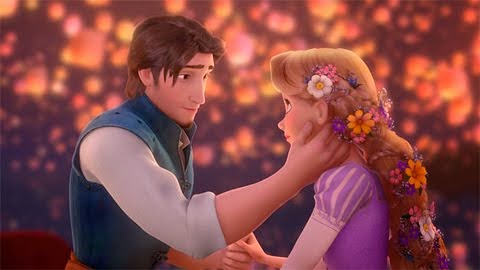
            Tangled is unlike most Disney films that have been produced in the past and presents a more modern version of the classic fairytale. Although the film does have several cliché messages that most of the Disney films hold, the way they are presented is done in an effective way where the viewers of the movie, adults and children included, take away moral messages. A few potentially problematic messages are implied, but the good messages outweigh these by far.
            The most apparent cliché message in this film is that a girl has to be saved by a boy, particularly from a castle in this case. Flynn Rider, a thief, finds himself in this castle when he is trying to escape from people chasing him because he has stolen the princess’ crown. Rapunzel then gives him the proposition that if he takes her to see the floating lanterns that appear every year on her birthday, she will give him the crown back. This is unlike most Disney films where the prince willingly comes into the castle to save the princess. Rapunzel, the female lead, has full power and control, which remains throughout the entire film. It teaches girls that they are strong and are able to do whatever they want to in life. This leads to the next cliché message that one should follow their dreams.
            The entire journey that is shown in Tangled is Rapunzel trying to get to the castle so she can see the floating lanterns. On her journey, there is a time when she is trying to convince people not to take Flynn Rider away because he is helping her follow her dreams. The other characters that are depicted as mean sympathize with her and all share the stories of their dreams. A message is taught in this scene that everyone has a dream and people should be accepting of other peoples dreams and help them to achieve these dreams. This appeals to the argument of pathos because everyone in life has a passion for something that they want to pursue. While watching this movie, one may think of their dreams and be encouraged to follow them.
            The last major cliché message is that true love conquers all. In the last scene, Rapunzel starts to cry because Eugene is dying. Once her teardrop falls on his face, he gains consciousness and pronounces how he wants to be with her. Although this sends the false message to children that true love can save anything, it does teach the message that love will lead you to happiness. In the beginning of the film, Eugene is a thief and is only concerned about becoming wealthy and having a castle. By the end of the film however, he realizes that money cannot make you happy, only love can.
            Other moral messages that Tangled teaches its audience include finding courage within oneself, accepting yourself, and self-sacrifice/selflessness. Rapunzel has been locked in a tower for 18 years and does not know what to expect beyond those walls. She has to find courage within herself to step outside of her comfort zone and do what her heart tells her to do. Eugene teaches the audience to accept yourself for who you are. It is not until him and Rapunzel are about to die that he reveals his real name to Rapunzel and his background story of being adopted. Up until this point he has pretended that he is a very tough guy who only has the concern of becoming rich, not caring about other people’s feelings. When Eugene is dying at the end of the movie and believes that the only way he can be healed is through Rapunzel’s hair, he sacrifices his own life by cutting off Rapunzel’s hair so that she will not have to stay in the tower forever keeping the woman who raised her young. This teaches to put yourself before others and again emphasizes the fact that true love is what is important in life.
            “Good looks and sex appeal are compelling traits, predisposing us in favor of a given character”
(Giannetti 406). Rapunzel and Eugene, the good characters, are both attractive. Rapunzel has a tiny waist, big green eyes, and long blonde hair. Eugene is tall, dark, and handsome. The bad characters in the film “are played by actors who are made to look unattractive” (Giannetti 406). For example, the two thieves and thugs are depicted with unattractive features, including big noses, eye patches, missing teeth and hair, and being overweight. This could send a problematic message to children, appealing to the argument of logos, that attractive people are kind and will have their dreams come true, while unattractive people are mean and associated with bad behaviors.
            Overall, Tangled teaches several good messages while only having a few possibly problematic messages. Even though there are some cliché messages, the way that they are done is not in the typical fashion. They do not simply imply that just because you are pretty or have a dream you will get everything handed to you. It teaches that in order to be happy, achieve your dreams, and find love, you have to have courage, be selfless, and accept yourself for who you are. I rate Tangled with four slurpees because it teaches children major life lessons in a more realistic way than most movies do, but at the same time still having the fictional aspects that make it especially enjoyable and entertaining to watch.


Stop Hating On Disney

           
           In 1998, Disney came out with a charming children’s film called Mulan. This movie is about a Chinese girl living in China during the threat of the takeover of the Mongols. When war is uprising, the government calls one person from every family to come and fight. Her father, a previous war hero who is also injured, steps forward as the man in the family to fight. In order to protect her father as she knows he will die, Mulan cuts her hair overnight and steps into the army pretending to be a man. Though this film has cliche positive messages, there are some messages about gender roles that could potentially affect the children who watch them.
            This movie differs from other Disney movies in that traditionally, the “prince” saves the “princess,” but in Mulan the “princess” ends up saving the “prince.”  Mulan includes an important message to children, that you have the potential and ability to do whatever you want no matter what people think of you. Mulan proves that you can breakaway from the judgements people make towards you, and prove yourself and worthiness. In the beginning of the film, Mulan is not seen more than a beautiful future bride who has no business taking part in masculine things such as war. These easily noticeable cliche messages act as an ethos appeal and establish an immense amount of credibility to the films, allowing more and more parents to let their kids watch them. As Andrea Lunsford states in Everything’s an Argument, “Audiences pay attention to ethos and the values that it represents” (Lunsford 53). With these positive cliche messages, Disney becomes an easy target for critics who claim that Disney films can include whatever they want in their films without any credibility consequences.
            Similarly to other Disney films, Mulan receives significant criticism for this positive cliche message to be also sending a negative message to children; more specifically gender roles. In the beginning of the film, a scene takes place as Mulan is dressed up to visit the sacred “match maker” who is in charge of finding Mulan and other Chinese girls a man to marry. During this scene, the characters sing a song about how this is pretty much the most important moment in their life, and that the way they look is priority number one when meeting a man. Mulan’s mother and her friends tell Mulan that “men want girls who are calm, obedient, work fast paced, make good breeding with a tiny waist.” Writing it out in words makes the message that women are products that are matched up with men with a “match maker” much more present. Unfortunately, when the lyrics are coincided with a catchy cute song, they are looked past.

https://www.youtube.com/watch?v=ZnUEDaeoF0Q

Another scene and song that supports this message of specific gender roles is during Mulan and the Chinese Army’s training in the catchy popular song “I’ll Make a Man Out of You.” During this song, the captain and trainer sings about how to “become a man,” and the things that one does to achieve that; to be more specific, he explicitly states that to be a man you must be “swift, forceful, strong, fierce, and mysterious.” If you watch the matchmaker scene and this scene back to back, it becomes very evident how much of a “joke” the women’s displayed roles in this movie are. This is not just potentially harmful to young girls but young boys too. This song and scene is explaining that to be a man you need to be “strong, fierce, and forceful,” and includes nothing about inner self or personality except maybe being “mysterious.”

https://www.youtube.com/watch?v=ZSS5dEeMX64

            The strategy to include these themes subliminally in the film takes its place with the use of pathos. In case you haven’t noticed, everything mentioned so far about subliminal messages in gender roles have involved the music. If in the matchmaker scene, one of the characters overtly stated “in order for a man to like you, you need to be calm, obedient, work fast paced, make good breeding with a tiny waist,” then Mulan would probably receive a lot more criticism for sexism than it does now. What gets the message across that it is okay to state these things is the catchy cute song that goes along with it and the positive fun mood and emotions it brings. In Understanding Movies Louis Giannetti states, “music can serve as a kind of overture to suggest the mood or sprit of the film as a whole” (Giannetti 214). Without the uplifting emotional spirit that both of these songs include, the hidden messages would not be as successful in reaching the audience.
            So does this movie have a negative impact on children? Many Disney critics say yes. But think about the setting and time period of this movie. It is indeed a fact that during the Han Dynasty in China, these gender roles were completely accurate. During this time period, China was threatened by Mongolia as they invaded their land and burned down villages, in response men would fight back while women took care of everything else; just as in World War II, men would fight and women would raise and teach the kids. During a time of war, things change and it would be inaccurate to say that strength and fierceness of men was not important at this time of destruction of China’s homeland. In the movie, Mulan ends up breaking her stereotypical gender role and instead becomes a war hero. So in a way, Mulan shows that gender roles are NOT necessarily a good thing.

            Mulan’s positive themes of courage, family importance, and not letting people hold you back based on judgements absolutely outweigh the noticeable negative messages of gender stereotypes. In fact, they need to be there in order for this movie to be accurate and portray a positive theme. Disney films receive an immense amount of criticism for being racist, sexist, and teaching bad messages to kids, but growing up as a Disney watching kid myself, I believe the things that people say are wrong with Disney films are not major problems in my generation. In order for a movie to be great, there needs to be a problem and a solution, and this is exactly what is present in Mulan; a girl is underestimated, she proves herself in a way not even the strongest man could do. Five slurpees.