Thursday, February 28, 2013

Arbitrage- Sponsorship for the One Percent


There might not be a better place in the world for a company to advertise its product than in the heart of New York City.  Look in any direction from any vantage point in the metropolis and you are sure to see hundreds of logos, pictures, and slogans advertising specific products and services.  On Wall Street, corporations from around the globe are represented, and the plethora of things they sell or do has a special presence in this global city.  A noteworthy movie that takes place here is Arbitrage.  This film, like the Wall Street movies, takes the average viewer into the upper reaches of New York society, into the lives of the one percent.   It has an interesting, if not always easily followed, storyline, and a solid cast headlined by Richard Gere performing as multi-billionaire corporate head Robert Miller.  However, Arbitrage also is a movie that flies under the radar for a select few reasons.  It falls short due to its occasional subpar audio techniques, high-end financial terminology that can be hard to follow, and an abrupt ending that really left me wondering whether I had made a good decision watching this film.  Regardless, the movie creates an ideal platform for advertisers looking to get a product or service into the cinema.  You can probably divide up this film into three categories: implicit, drawn out use of particular brands, explicit shots of corporate logos in the scene, and oral advertising based on characters mentioning specific products.  These categories seem to coincide with this film’s appeals to ethos (ethics), logos (logic), and pathos (emotion) as a whole.

                Simply put, this movie is about the one percent.  When you think of ritzy, upper-class living, certain things come to mind: Mercedes-Benz, Tiffany, Giorgio Armani, Rolex and the like.  This film’s representation of the one percent needs to include these types of things if it is to maintain credibility.  The beginning of the movie involves showing the main character, an immensely wealthy corporate head, flying in his private jet from Miami to New York, disembarking, an being escorted to a waiting Mercedes-Benz.  This is the most obvious upper-class item that Robert Miller owns in my eyes, as it is more difficult for an average Joe like me to spot the other items someone like Miller and those that surround him.  Someone familiar with the latest fashion trends will probably be able to identify the particular suits that Miller is always wearing and the dresses that his wife Ellen wears to various parties.  The film’s producers will likely be concerned with an accurate portrayal of one of the country’s richest families, so they will be sure to include the latest accessory or fashion statement.  On the flip side, Mercedes-Benz probably had competition from BMW, Lexus, and Cadillac for the role of Miller’s choice of automobile.  Hence, both sides probably came out on top, as a premier luxury brand adds to the ethos of the wealthy New Yorker, and a premier spot in a major film about a one percent individual can become a selling point for Mercedes-Benz, which is only able to market its top-of-the-line cars to the wealthiest Americans.  In terms of cars, there is also a consistent appeal to a middle class viewer as well.  Miller’s friend Jimmy, a twenty-three year old African-American, who is the son of his former driver, drives a Jeep Grand Cherokee when he gets Miller out of a very delicate situation.  This is an appeal to the rest of us, as this is a vehicle with a reputation for being rugged and hard-working.  In Everything’s an Argument by Andrea Lunsford, analyzing an argument based on ethos requires personal interpretation of the details (Lunsford 102).  In advertising, this means looking at the situation carefully and asking if such a product is fitting in this time and place.  Jimmy is clearly not as well-off as Miller, and hence has a middle-class automobile.  He is also African-American, which creates a tricky background for establishing that fact.  Does the rugged Grand Cherokee, a fairly expensive SUV, characterize Jimmy as a hardworking-man making a name for himself, or, when compared to what surrounds Miller, does it make him look poor and draw further attention to his race?  This exemplifies the decisions that an audience member will have to make in order to properly judge a character.  It all comes back to ethos, which the corporations whose products and services are placed in Arbitrage certainly need to take into consideration.

                Most sponsorship in this film is not comprised of long, drawn-out use of the product or service by the characters.  More often, the audience catches a glimpse of the company’s title, slogan, or logo.  Not surprisingly, these are all appeals to logos, as the audience will logically decide whether to acknowledge the corporation in a positive or negative way upon seeing its advertisement.  The first blatant advertisement that appears is a massive logo on the side of a Manhattan skyscraper, the word MetLife.  This hinted to me that there would be a lot of advertisements to come.  One that really stands out appears in the form of an ad on the roof of a taxi that Miller is getting out of.  It is for Men’s Wearhouse, and I immediately asked myself, “Does Robert Miller buy his suits at Men’s Wearhouse?”  The answer is obviously no, as he is much too wealthy to shop at such a mainstream store, but the fact that I made such a connection means that the advertisement did its job.  If an ad sticks in a viewer’s mind for any length of time, then the marketing firm for the corporation has done its job to some degree.    Another scene that features a particular product very prominently is a conversation between Miller and his daughter, Brooke.  They are discussing his sale of the company, and she pulls out a copy of Forbes Magazine, which has him featured on the cover.  I thought to myself, that if such a business executive has a subscription to Forbes magazine; real investors might be convinced that Forbes puts out sound business advice.  Just seeing the brand name of the publishing company made it stick in my mind for about ten seconds, which is more than long enough for me to be able to recall it at a later time.  These random acts of cinema sponsorship seemed subtle enough in my book, but were Brooke and Miller's personal handlings of the magazine a bit too blatant as far as cinematic advertising is concerned?  In the article he wrote for the Orange County Register, Martin J. Smith discusses the views of some critics of cinematic advertising.  Those who want paid advertisements to be listed beforehand often say that product placement like this is not realistic but rather anti-realistic (Smith 2).  They would certainly disapprove of Miller picking up the name-brand magazine, examining it, and tossing it aside.  I believe that, while they have a case in this scene, the title of the magazine can only be seen for a split second, enough time to advertise the product but not enough time to flaunt the name of the product.  Regardless of which side you're on in this case, the product placements appealing to logos certainly do their job.  This film is money well spent for the advertisers.

                Several implied advertisements come in the form of a character orally mentioning a corporation.  These are appeals to the pathos of the viewer, as one will most likely either have an immediate positive or negative reaction to the direct mentioning of a product.  There are two scenes late in the movie that evoke a response when a character mentions a product or service.  Miller and Jimmy are arguing in the latter’s apartment late one night.  Jimmy tells Miller that he plans to go to Virginia to work and Miller asks what he plans to do.  Jimmy replies that he bought an Applebee’s, and this response both catches Miller off guard and made me laugh a little inside.  I said to myself, “What a time to mention something as random as a restaurant chain!”  If the majority of viewers had the same reaction that I did, the result could be one of two things.  People who had seen the film might start to joke about this scene and either decide to go to Applebee’s or to avoid the popular chain.  This is a risky advertising move on the part of the chain, as they could lose a few patrons because of it.  However, I don’t think that a chain as big as Applebee’s will do too much worrying about a few patrons.  The other scene that involves an oral advertisement is when Detective Briar is talking about Miller, who he knows is responsible for the death of a young art dealer.  He says that “one doesn’t not go to jail just because he’s on CNBC.”  I personally thought to myself, “Well, that’s a fitting reference in a movie set on Wall Street.”   However, this is not the only reaction that could be derived from this.  If you are someone who watches Fox Business Channel, you might snicker to yourself, believing that you have a better trading strategy than even Robert Miller.  All-in-all, the reference to CNBC, which proclaims itself as "First in Business Worldwide" shows us how big the NBC corporation's business channel is.  Whether this has a positive or negative effect on its ratings is entirely up to the interpretations of the viewer.  These oral advertisements are tricky, but if done right, they can be a home run for sponsoring corporations.  For Applebee's and CNBC, they will just have to wait and see what the fallout is going to be like.
                Was Arbitrage a Hollywood smash hit?  The answer is no, but most of the advertisers in this film got through pretty much unscathed and probably gained a handful of users of their product in the process.  The rich people who watch this movie won't help but notice the high-end products being used, the advertisements plastered on the streets of New York  help set the scene and stick in the minds of viewers at the same time, and the implied oral advertisements have potential to gain patrons or viewers.  In all, I have to give advertising in this film two tickets.  I do this mostly due to the fact that Applebee's and CNBC have something to lose in regards to their oral product placement.  Again, a few patrons or viewers will not make or break their reputations, but perhaps they could have gotten their names out in a different way.  In all though, it seems that both movie and advertisers got through this unscathed and stand to gain in today's world which is increasingly centered around what Robert Miller held dear, money.


Transformers: Dat Camaro


The Camaro: Fine as the Ticket on the Dash

            In the summer of 2007, Transformers awed millions worldwide with loads of action, Megan Fox, and a really badass car. For those not too familiar with Transformers, it revolves around the rivalry between Autobots and Decepticons, alien robots from the planet Cybertron. The main character, Sam Witwicky (Shia LaBeouf), buys an old school Camaro in order to impress the girl of his dreams, Mikaela Banes (Megan Fox). Soon, we discover that Sam’s Camaro is an Autobot, named Bumblebee, who helps in the war against the Decepticons. After battling a Decepticon disguised as a Mustang, Mikaela questions, “If he’s suppose to be an alien robot, why does he turn back into this piece of crap Camaro?” Taking offense to this, Bumblebee pulls over, ejects both his passengers, and rides off. However, after transforming himself, Bumblebee comes back as the all-new fifth generation Camaro. I remember, at that specific moment in the movie, my jaw dropped in awe of the sexiness of the Camaro and with only one word coming to mind, “damn."
            When the Camaro rolls in on the screen, the pathos of the Camaro is reflected in this particular scene and throughout the movie. As guys, cars are part of our natural habitat. I mean for us, cars are a lot like girls, you don’t have to be an expert to appreciate a beauty when you seen one. The first time we see the Camaro roll up, it’s the equivalent of love at first sight. Within a matter of seconds, we invest so much emotion and love towards the Camaro as soon as our eyes make contact with it. From then on, all we can think about is the being the person behind the steering wheel. While falling in love with a great piece of machinery can go either way for guys and girls, Transformers mainly targets men, for the person in the passenger seat is no other than the lovely Megan Fox.
            The logos tied into the Camaro is the fact that if men own one, then we too could have a bombshell seating in the passenger seat. When Transformers came out in the summer of 2007, I was 14-years-old and one of many that instantly fell in love with Megan Fox. According Louis Gianneti’s Understanding Movies, “Good looks and sex appeal are compelling traits, predisposing us in favor of a given character. Sometimes an actor’s appeal is so strong that he or she can win over an audience…” (406). Think about it from the male point of view, you have your average American guy, with a really cool car, that ends up with a smoking’ girl like Megan Fox, you bet I’m all in to invest in a Camaro! The same would work for girls, if the protagonist were a girl who was able to win over Ryan Gosling with a car; this would easily win over the female audience. However, it’s not just the fact that we have increased chances of getting a good-looking girl (confidence alone gets that done), but the fact that the Camaro is also displayed as the toughest car around. When your country goes to war with alien robots, Transformers shows us our best bet is to send in the Camaro. Bumblebee proves that if a Camaro can outlast explosive battles, it can certainly withstand traffic. After seeing Transformers, many had already established a relationship with the Camaro that they would be bound to buy one as soon as they hit the market.
            Transformers was the perfect opportunity to introduce the newest upcoming model for the all-new 5th generation Camaro. The ethos surrounding the Camaro established relationships with people that saw Transformers and those who fell in love with the car.  Since 2009, when the new Camaro finally went on the market, sales of the car skyrocketed to point where it’s now one of the most abundant cars on the road. The Camaro hasn’t just been a dominant force in the car industry but also society and pop culture. In The Orange County Register, Martin Smith points out, “…the impact of product placement goes far beyond revenue…” (3). The Camaro has become an icon for the Transformers franchise, it’s now amongst the elite of superior American built cars, and little kids have grown up thinking any yellow Camaro on the street is actually Bumblebee!
            When Transformers came out, I was among many that thought the Camaro was by far the coolest thing ever. It has become an icon on another level. We have grown attached to the Camaro on the big screen and the road. When you see one, you just can't help yourself but make a double take. If in fact you come across a yellow Camaro and wonder if it’s a Transformer…It is, he’s just shy.


Skyfall


Skyfall.
As a diehard Bond fan, when Skyfall came out in theaters I was first in line to catch the midnight premier. As the film started, I was once again filled with the joy of seeing Bond hove into sight in a well fitted suit (courtesy of Tom Ford), driving a sleek Jaguar sports car, and drinking… a Heineken? What happened to “shaken not stirred”?!

Marketing and James Bond have gone hand in hand since the start of the franchise. Men want to be him, and women want him. Bond is the image of suave, stylish sophistication and many men believe that wearing the suit, driving the car and drinking the martini is an easy way to achieve that timeless look. However, in the new film, we see Bond skipping over his regular martini in favor of a cool crisp Heineken. This obvious and unusual image is not only out of the ordinary but, for many people, implies a sellout. Smith explores in his advertising article that “partnerships help pay for the cost of the movies” (Advertising 3) and I can only imagine how much Heineken must have shelled out to become the new preferred beverage of Bond. This for me is a huge hit to the ethos of the film. Its credibility and constituency have allowed them to develop a solid character and franchise over the last 40 years or so of filming and with this blatant switch in preferred drink, it makes me wonder what else this franchise is willing to change for the right price.


But that’s not all the new Skyfall gets me excited about: the cars. Cars, sports cars especially, are always a huge pathos and logos draw in the bond films. In Skyfall in particular, Bond drives a Jaguar XJ, the signature Aston Martin makes an appearance, and Land Rover features heavily throughout the film in a lot of the chase/action scenes. Cars are a huge pathos draw because they establish envy and create, as Lunsford explains in Everything’s an Argument, “quick and irresistible connections between audience and argument” (Lunsford 44). You feel envy towards Bond for the life he lives, and you realize that even if you can’t be a super spy, you can drive a Jaguar or an Aston Martin. The pathos argument has delivered you into the hands of the advertisers once again. However, cars can also be a logos draw. Its logical for audience members to associate the standing of the characters with the kind of car they drive. WE expect Bond to drive a Jag because it fits with this image logically. Can you imagine Bond in a SmartCar? Didn’t think so.


The final piece of the puzzle for Bond is his suit. Daniel Craig’s Bond get his suits tailored at Tom Ford for the low price of about $4000 a suit. While this is the least aggressive marketing in the film, it’s enough just to know that Bond wears Tom Ford to create that association without ever having to see the label in the film. As Lunsford states in Everything’s and Argument “the clothes people choose to wear can be an argument and make a statement” (Lunsford 44). Bond wears Omega watches and Tom Ford suits, so if you want to be like him, you can foot the bill and buy the clothes. This again falls under the envy and idolatry of pathos, and the logical connections between wealth and masculinity of logos.

So while Bond and his product placements will always go hand in hand, Skyfall does a fairly good job at keeping the mentions subtle and well placed, not distracting from the actual film, but giving all the products the positive press that comes along with being associated with James Bond. So with all that in consideration: I have to give Skyfall and its’ product placement 3 Heinekens out of 3. Cheers.


Transporter 3 and the Audi A8


As you might have noticed, the popularity of Audi has dramatically increased in the past five to ten years. But, Audi hasn’t always had the positive image it has today. Most people can remember when Audi went through accusations of acceleration problems in one of their most popular models. Over 700 hundred deaths were said to have been caused by Audis produced from the 1980s. This negative stigma and ethos haunted Audi from the late 1990s to the early 2000s with sales at record lows. Audi needed to make a change. After countless design renovations, in the mid 2000s they finally nailed a sleek and sexy body style that exceeded all safety tests. Audi decided to make a big comeback and teamed up with the movie Transporter 3 showcasing their newly redesigned Audi A8. The plot of each Transporter movie involves Jason Statham driving an awesome car, completing the designated task, and avoiding all danger thrown his way. Audi has had a negative ethos for years but the use in Transporter 3 shows just how far they have come and how highly people think of Audi now.


So what does this movie let us know about Audi? For starters, it beats the competition. The Mercedes E class is the closest competitor to Audi in luxury sedans. In the epic car chase scene, the Mercedes is no match for the Audi, further suggesting its superiority. The whole movie seems like an extended Audi commercial with close ups on the logo and showing flashy technological features in the new A8. The movie suggests that the Audi A8 can off road, drive on two wheels between two eighteen-wheelers, and reach speeds of up to 220 km/hr. Oh and apparently it’s also bulletproof. Now I’m fairly certain it can’t do any of these things, but it sure looked cool when Jason Statham did it. In Everything’s an Argument, Andrea Lunsford claims, “A more obvious way to build an emotional tie is simply to help readers identify with the experiences,” (Lunsford 34). This one scene alone could have earned Audi several millions dollars and thousands of potential clients. Had the car not been able to out perform the Mercedes, both the main characters would have died. But because the Audi was able to reach top speeds while still maintaining stability, the bad guys were the ones who died. This might subliminally suggest to viewers that the good guys drive Audis and the bad guys drive Mercedes. All of these elements are affecting viewers’ pathos and convincing them to love the car. Lunsford states: “placement and advertising for certain products and brands is an extremely strong argument in itself” (Lunsford 328). By placing the Audi A8 in plain view for the majority of the movie, Transporter 3 is making an argument for the car. The argument is simple: buy the car, live the same adventurous lifestyle.


The use of the Audi A8 in Transporter 3 definitely benefitted both parties. The movie gets to use another awesome car, which helps add to the appeal of their movie. Audi is definitely benefitting from the use of their A8 because people will want to say they own the car from Transporter 3. The use of the car affects viewers emotions making them want to own the car. Majority of the movie is spent inside that car connecting the characters to the Audi. For Audi to benefit, the endorsement in Transporter 3 needed to appeal to viewers’ logos. For example, if you buy the new Audi A8 you will look just as awesome as Frank Martin (played by Jason Statham) does driving it (IMDb). The movie could stand without the A8 and could easily be replaced with a different car, yet they chose this car because like the main character Frank, the Audi A8 is practical yet adventurous and sophisticated. The Audi A8’s use in Transporter 3 appeals to viewers’ ethos, pathos and logos. Every time the car is driven or seen is another attempt at persuading the viewers to go out and buy the car. This movie earns 3 out of 3 tickets for excellent use of a product endorsement.


Reign Over Me


Adam Sandler and Don Cheadle star in Mike Binder’s 2006 drama-comedy, Reign Over Me. Set in New York City a couple of years after the 9/11 attacks, Charlie (Sandler) has lost his family and life in the horrible terrorist attacks, when his college roommate, Dr. Johnson (Cheadle), randomly finds him and they continue their friendship and help each other along in ways they will never know. Since the loss of his loved ones, Charlie has lost all will to live and his social standing and etiquette and communication from his battle with depression and struggle with post traumatic stress disorder. As they fight these battles with each other and work through these problems with one another, some wonderful product placement takes place in this indie flick.
            In our text, Everything’s an Argument, it states that “placement and advertising for famous products and brands is an extremely strong argument in itself.” In the first ten minutes of the film there is an immediate sense of advertising in this “low-key” film, which surprised me. During the intro, as Adam Sandler’s character is driving on what appears to be a Vespa motor scooter down a strip in rural New York City, one can clearly see an ACE Hardware sign and the neon lit sign and emblem of McDonald’s. This connects with everyone that lives in the U.S.A. Logically and emotionally, poor people and rich people can make connections with both of these franchises for different reasons. In the next scene, it shows Don Cheadles character, who is a well-off practicing dentist, driving a Volvo hatchback. The cinematography chooses to specifically show a frame with the actual Volvo emblem on the front. As Charlie and Dr. Johnson become closer friends again, Charlie invites Johnson to his place. As you walk by his music room, one can distinctly see a pair of Gibson guitars and a Ludwig drum set. Charlie finds his escape from his mental illness in music and drowns himself in it. If an audience member sees that an avid music lover like Charlie is playing Gibson and Ludwig instruments, they might check out the products and buy them. Because he is such a music fan, Charlie also has a gigantic vinyl album collection. Several music choices that he chooses to mention and bring up are The Pretenders, Bruce Springsteen, Bob Seeger, and Earth, Wind, and Fire. Even the sound designer would choose a clip from those certain albums to use as background music to support the scene and the advertising of these bands and their records. The title “Reign Over Me” is actually pulled from the song, “Love, Reign O’er Me” by The Who, and Charlie uses this song to escape from his reality and the problems that he faces. Logically, using well known classic artists like these is genius. It will connect with the older generation who lived through that time period, and spark an interest in the young generation that might not know about cultured, pivotal music such as those mentioned, and maybe they will look them up or buy their old albums. In the next scene that takes place at a bar, you clearly see Dr. Johnson order a Heineken at the bar, which is a very smart marketing ploy to have the actual product used in the context of the scene.
            There are two products that are mentioned quite heavily: Captain America and Barq’s root beer. These are two of Charlie’s absolute favorite things. He drinks root beer almost everywhere he goes, and loves reading and showing the comics of Captain America to Dr. Johnson. While random, I think both of these products are very likeable and underrated products that sometimes lack advertisement. The biggest advertisement in the film was the Playstation 2 game, Shadow of the Colossus. This game played a very big and pivotal part in this story. You spent minutes of this film watching them play through levels of this mythical game, and it gave off a vibe in the film that this game meant a lot to these two men. There were some odd connections made between the game and the story. It was a literal escape for Charlie. He could just enter into this world, and I think the company marketed it off of that aspect, and it was great for their publicity, especially because the game had just came out a year earlier.
            Indie flicks can indeed have good, if not great, marketing and product placement in places and scenes that one wouldn’t normally think to go searching for it at. “Reign Over Me” certainly accomplishes that. The director, David Binder, made it so natural that you sometimes have to really concentrate and look for products to notice them at all. That is why American consumers will buy these products!

Casino Royale

Casino Royale (2006): Racing from the Past towards the Future

     The Bond franchise embodies the words, class and mystery. In the current films, starring Daniel Craig, the scenes are full of elegant products worn or used by 007, himself. The film Casino Royale does it part to establish the classic Bond image using high quality products, not only for Bond but also for the other characters and the locations as well. The one thing that most people connect with the Bond franchise is the cars and the quality they add to the movies. Casino Royale is no exception to the usage of classy cars, and the placement of the cars throughout the film effectively draws appeal to the cars as products and the film.
    First, my attention is immediately drawn to the many beautiful cars in the film. The first car that Bond is driving is a Ford Mondeo. Clearly from the beginning of the scene that involves this car, it was pure product placement. We see Bond driving the Mondeo down the highway to his motel in the Bahamas. The Mondeo is just a modern sedan that an everyday businessman would drive. The vibe that the car is giving off in the film is if Bond drives this car and look great doing it, any businessman can too. The driver is not just another person stuck in traffic, but someone who has class and a mystery about them, just like Bond. People will buy just about anything to look cool so logically since Bond drives a Mondeo, anybody who drives a Mondeo will be like Bond. Ford definitely wins with this product placement because Bond’s image elevates the car’s appeal. Now anyone driving a Ford Mondeo can image what it feels like to be 007 driving down the highway.
    Next, Bond wins an Aston Martin DB5 from one of the villains, Alex Dimitrios, in a poker game. Bond fans know that 007 and Aston Martin have a history. In an article on the Aston Martin website, the news section announces the use of Aston Martin again in Casino Royale and references the long relationship, “The association with the marque began in 1964 with the film “Goldfinger” when the DB5 was fitted with “optional extras” such as ejector seats and rockets” (Bond back with Aston 5). The DB5 is an older version of the Aston Martin as it was in Goldfinger in 1964. The connection DB5 and Bond provides a mutual benefit. Aston Martin receives an image that only James Bond can provide, and Casino Royale lets past Bond fans know it’s sticking to the roots of Bond. The image of Bond and Aston Martin together emphasizes the class and power of both. Since the DB5 is an older version, it’s not the main version associated with Bond in this film.
   When 007 arrives at Casino Royale, an Aston Martin DBS is waiting for him. The DBS was released the year after Casino Royale was released in theaters.  A brilliant marketing campaign by Aston Martin was to associate its new product with an old relationship. Using a newer Aston Martin displays, though upgraded, Bond is still the same. Fans of the classic Bond are happy and can appreciate the film’s effort for keeping similar elements. People are drawn to buy the DBS since Bond an old buddy of Aston Martin’s and he upgraded his image with this car. We can now be upgraded to 007 status if we buy the car. It’s logically the only car to own, if you want to appear as refined and mysterious as James Bond. Envy comes into play with this car. Not only do we want to own the car, but we want to be Bond driving the car down the beautiful Montenegro streets. Aston Martin didn’t realize the deal they were getting many years ago by allowing the 1964 Aston Martin DB5 to be in a Bond film. The relationship between the Bond franchise and Aston Martin is mutually successful. Bond gains a car that matches his image and, “the company gains credibility in the bargain” (Lunsford 49). If a 007 trusts his life with this car, then it must be safe for anyone to drive.
   The product placement of the three cars Bond drives was beneficial to the car companies as well as Casino Royale. Someday I would love to own a Aston Martin and be a Bond girl. Move over Moneypenny. I give this movie 2/3 tickets.

Top Gun and Ray-Ban


Top Gun and Ray-Ban a Match Made in Heaven

When most people think of American films in the 1980s they think of Top Gun. Although this movie was made before my time, I still consider it one of my favorite movies of all time. Its influence on American society is not lost on most. Men want to be Maverick and women want to be with him. This makes him the ideal candidate to use for product placement. Ray-Ban was able to take away from the hit movie with the ultimate product placement that resonated with most Americans through the use of ethos, pathos and logos. This is an incredibly successful example of product placement in the movie industry.
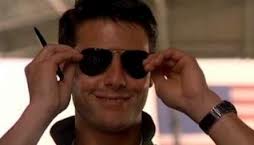
Pete “Maverick” Mitchell is the ultimate bad boy fighting for the right team. This character appeals to most audiences especially in the context of the story of American heroism. Ray-Ban was able to capitalize on this display of ethos by getting Maverick to wear only their glasses in extremely pertinent scenes of the movie. The reason that the placement is so successful is because of the character they are featured on. According to Giannetti, “The filmmaker uses actors as a medium for communicating ideas and emotions,” (Giannetti 283). Top Gun appeals to the average American through the use of an egotistic male character that people love. Ray-Ban saw this and was able to take advantage of the success of the character that is Maverick. If the character was less loveable then this would have been a less successful attempt at product placement. Fortunately for Ray-Ban, Maverick is the ultimate show of character in a movie.


Another way to measure the success of product placement is the way that the movie appeals to the pathos of the viewer. Top Gun does an impeccable job playing off of the audience’s emotional investment in the movie and Ray-Ban piggy backed off of that success. Ray-Bans aren’t always seen in the movie, only in the scenes that stick with the audience including: the volleyball scene, anytime Maverick is outside of his plane on the runway, and the scene after Goose dies. These scenes are the ones that stick with viewers allowing Ray-Ban to be seen in a multitude of scenes throughout the movie that are all different, showing their versatility. This product placement is golden because it shows their sporty side as well as their side that darkens when a death takes place. Andrea A. Lunsford says that people “sometimes want to use emotions to connect with [viewers],” (Lunsford 33). Ray-Ban appears in the scenes that the viewers feel the most emotions therefore making the viewers emotionally connect to their sunglasses. These aren’t the only scenes the glasses appear in, but they are conveniently placed in the scenes that associate with our emotions. Whether this was the doing of the Top Gun team or the people at Ray-Ban, it was a job well done for product placement in the right emotional spots.
            While pathos and ethos both have a large stake in product placement, the most important part of product placement is the logos. If the Ray-Ban sunglasses were put in the improper scenes then the product placement would have been a fail. Since Top Gun and Ray-Ban were able to work together to logically place the sunglasses in meaningful scenes, the product placement worked well. One of the scenes that stands out the most is when Maverick and Goose have just landed from a flight that was extremely risky and they really didn’t quite follow the rules but got the job done. They are both walking on the tarmac sporting their Ray-Ban’s. This is a scene that makes sense for the iconic sunglasses to be worn in because it’s really where Maverick proves himself as a dangerously good pilot and as a dominant character. According to Lunsford we appeal to “arguments based on facts, evidence and reason,” (Lunsford 56). In scenes like the previous one the fact of the matter is Maverick is one cool cat and to have him wearing Ray-Ban sunglasses makes Ray-Ban’s look even cooler. This was one logically thought out move.
            Iconic movies are often made iconic by the items within them that help describe the character set. In Top Gun Maverick is known for his cool demeanor and his even cooler bomber jacket and Ray-Ban sunglasses. These sunglasses are epic throughout the movie and appear in several scenes appealing to the ethos, pathos, and logos of the viewer. Because they are subtle yet defined in the movie I give it three out of three tickets. I found the product placement tasteful because I knew it was there but I was not bombarded by it. Top Gun and Ray-Ban were a match made in heaven.